

A mid taper fade gradually shortens the hair around the temples, sideburns, and neckline while keeping more weight through the main sides than a traditional mid fade. The “mid” describes where the taper begins, but the exact height and shortest length can vary between barbers. That is why a clear barber request matters.
This haircut works with straight, wavy, curly, and coily hair. You can pair it with a textured crop, curls, quiff, side part, slick back, or longer top. The right version depends on your hair density, growth pattern, face shape, lifestyle, and how often you want to visit the barber.
What Is a Mid Taper Fade?

A mid taper fade is a gradual haircut transition that becomes shorter around the middle portion of the sides before tightening around the sideburns and neckline.
Unlike a full fade, the taper does not necessarily remove most of the hair across the entire side panel. More weight can remain above and behind the ear.
The result is a clean outline with a controlled amount of contrast. It can look sharp without making the sides appear completely exposed.
Where does the taper begin, and what hair is removed?
The taper generally begins around the temple or slightly above the top of the ear. The barber then reduces the length through progressively shorter clipper guards.
The shortest area may be:
- Skin or razor length
- Zero or near-zero
- A short clipper length such as a 0.5
- A longer base for a softer finish
The barber also shapes the sideburns and neckline. The amount of hair removed above the ear depends on how conservative or noticeable you want the taper to look.
Why can “mid taper fade” mean different things?
There is no universal measurement that every barber uses for “mid.” One barber may place it close to the temple, while another may start closer to the upper ear.
The term also does not automatically tell the barber whether you want skin, a 0.5, or a longer finish.
For predictable results, specify four things:
- Where the taper starts
- How short the bottom should be
- How much side weight should remain
- How long and textured you want the top
That information is more useful than simply saying “mid taper fade.”
Mid Taper Fade vs Similar Haircuts

Understanding the difference between similar cuts can prevent an unwanted haircut.
Mid taper fade vs mid fade
A mid fade generally removes more bulk across the sides and back. The fading area is broader, so the contrast is easier to see.
A mid taper concentrates the shortening around the temple, sideburns, and neckline while retaining more weight through the side panel.
Choose a mid taper if you want:
- More natural side coverage
- A softer overall silhouette
- A cleaner outline without exposing the whole side
- More flexibility as the haircut grows out
Choose a mid fade if you want:
- Stronger contrast
- Less side bulk
- A more obvious faded appearance
- A sharper, more dramatic silhouette
Mid taper vs low taper vs high taper
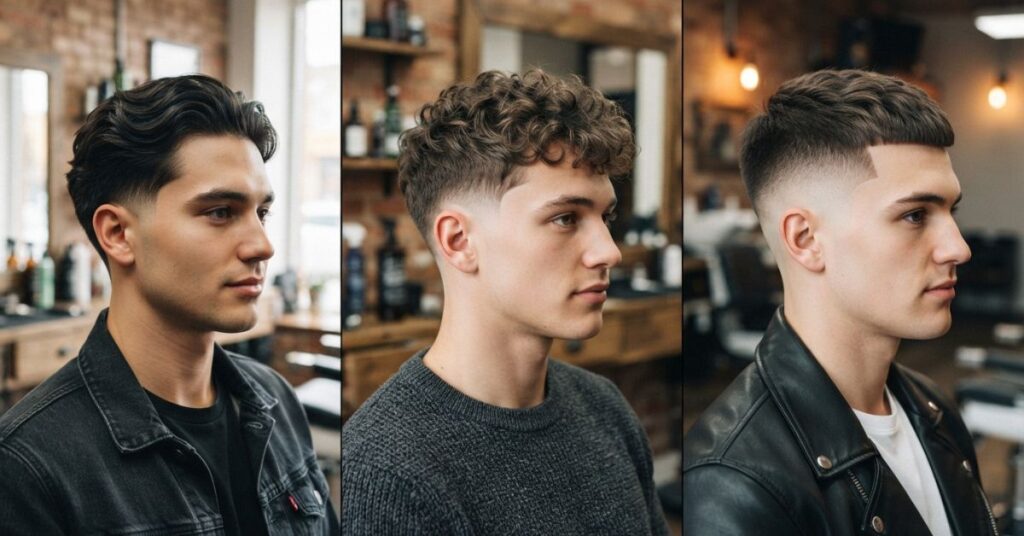
The main difference is placement.
| Haircut | Taper placement | Overall effect |
|---|---|---|
| Low taper | Close to the ear and lower hairline | Subtle |
| Mid taper | Around the temple and upper ear area | Balanced |
| High taper | Higher around the temple | Stronger contrast |
A low taper is usually the safest choice when you want minimal change to the sides.
A mid taper gives more definition without removing as much side weight as a high taper or broad fade.
A high taper creates a more noticeable transition and can make the top appear more prominent.
Mid taper fade vs temple fade and classic taper
A temple fade concentrates the shortest transition around the temple area. It can leave the rest of the sides relatively full.
A classic taper is usually more conservative. It gradually shortens the hair around the sideburns and neckline without creating the stronger contrast associated with many modern fades.
A mid taper sits between these ideas. It gives you visible structure while preserving useful hair through the sides.
Is a Mid Taper Fade Right for You?
The haircut is versatile, but the best version depends on your natural hair rather than the trend alone.
Hair type, density, and growth pattern
Straight hair: A mid taper gives straight hair a clean outline. Textured crops, side parts, quiffs, and slick backs are easy pairings.
Wavy hair: Keep enough length on top to show the natural movement. A matte styling product can define the waves without making them look heavy.
Curly hair: Preserve the curl pattern on top and avoid removing too much weight around the transition.
Coily hair: A mid taper can create a strong shape around a defined top, short coils, sponge curls, or other protective-style combinations.
Thick hair: The taper can remove visual heaviness around the edges while allowing you to keep a fuller top.
Fine or thin hair: Avoid an unnecessarily high or aggressive taper. Keeping some side weight can make the overall haircut appear fuller.
Your growth pattern matters too. A cowlick, uneven temple, strong hairline, or fast-growing neckline can change how the taper looks after several weeks.
Face and head shape and the desired silhouette
A mid taper is flexible because you can adjust the top rather than changing the entire haircut.
- Round face: Add moderate height or texture on top to create a longer visual shape.
- Square face: A textured crop, crew cut, or controlled top can emphasize the natural structure.
- Oval face: Most top styles work because the proportions are already balanced.
- Long face: Avoid excessive height. Keeping some top width can create better balance.
- Heart-shaped face: A textured or slightly fuller top can soften the contrast between the forehead and jaw.
- Diamond face: Moderate side weight and texture can help balance prominent cheekbones.
The goal is not to follow a rigid face-shape rule. Your head shape, hairline, density, and personal style all matter.
Lifestyle, dress code, and upkeep tolerance
A mid taper can work for school, business-casual settings, formal events, sports, and everyday wear.
If you rarely visit the barber, ask for a softer finish rather than an extremely tight skin taper.
If you enjoy frequent barber visits and want maximum contrast, you can request a tighter bottom and sharper edges.
Your haircut should match your schedule, not just your inspiration photo.
Best Mid Taper Fade Styles by Top Shape and Texture
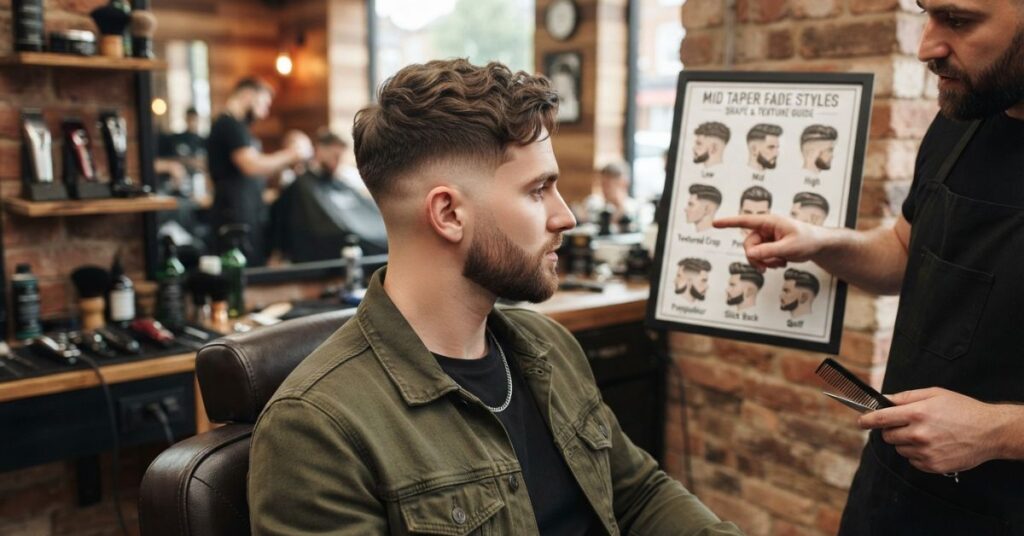
The taper controls the perimeter. The top determines much of the haircut’s personality.
Short and textured tops
Short tops are easy to maintain and pair naturally with a mid taper.
Good options include:
- Textured crop
- French crop
- Caesar cut
- Crew cut
- Short messy top
- Short curls
- Buzz-inspired top with a tapered perimeter
For fine hair, texture can create the appearance of more movement. For thick hair, removing some top bulk can prevent the style from becoming too heavy.
Medium and longer tops
A longer top gives you more styling choices.
Popular combinations include:
- Mid taper with a quiff
- Mid taper with a side part
- Mid taper with a comb over
- Mid taper with slicked-back hair
- Mid taper with a middle part
- Mid taper with a messy flow
- Mid taper with a textured fringe
Longer hair also makes the difference between a taper and a full fade more noticeable because the side weight creates contrast with the top.
Curly, coily, and protective-style combinations
Curly and coily hair can produce a particularly strong silhouette because the natural texture remains visible above the taper.
You can combine a mid taper with:
- Defined curls
- Short coils
- Curly fringe
- Sponge-textured curls
- Afro-inspired volume
- Braids or other longer protective styles
Tell the barber whether the top should be shaped while dry or wet when that affects the curl pattern. Curly hair can appear significantly shorter after it dries, so cutting decisions should account for shrinkage.
Finish options that change the look
The same mid taper can look completely different depending on the finish.
Natural finish: Softer edges and less aggressive contrast.
Skin finish: The shortest areas reach bare skin or near-skin, creating stronger contrast.
Matte finish: Best for textured, messy, and modern styles.
Shiny finish: Works well with combed, slicked, or classic styles.
Sharp lineup: Creates a more defined hairline and temple area.
Natural hairline: Better if you prefer a softer, less structured appearance.
How Do You Ask a Barber for a Mid Taper Fade?
The best barber request is specific without becoming complicated.
Set the placement, shortest length, and amount of bulk
Start with the placement.
Say whether you want the taper around the temple, upper ear, or another specific point.
Then state your preferred shortest length.
For example:
“I want a mid taper around the temples and sideburns. Keep some weight above and behind the ears, and finish the bottom at about a 0.5 instead of going completely to skin.”
This gives the barber more useful information than simply saying “mid taper.”
Specify the top length, texture, and transition
Explain what you want on top.
For example:
“Leave around two to three inches on top, keep the natural texture, and blend the sides smoothly into the top without taking too much bulk.”
If you have curls, mention whether you want them defined or shortened.
If you have straight hair, explain whether you want a fringe, side part, quiff, or textured finish.
Bring useful reference photos and confirm all three angles
Bring at least one clear reference photo.
Ideally, show:
- Front view
- Side view
- Back view
The side and back views are especially useful because they show how high the taper sits and how the neckline is shaped.
Do not assume the barber will reproduce every detail from a front-facing photo.
Use a concise barber-request script
You can use this simple script:
“I want a mid taper around the temples and sideburns. Keep the side panel fairly full, taper the neckline cleanly, and use a 0.5 at the shortest point. Leave the top around two to three inches and keep its natural texture. I want a smooth transition rather than a high fade.”
Adjust the length and shortest guard to suit your hair.
How Do You Style and Maintain a Mid Taper Fade?
A good taper still needs basic maintenance.
Daily styling by hair type and finish
Straight hair: Use a small amount of matte clay, paste, or pomade depending on the finish.
Wavy hair: Apply a lightweight styling cream and shape the waves with your fingers.
Curly hair: Use curl cream or another suitable curl product. Avoid brushing dry curls aggressively.
Coily hair: Use a moisturizing product that supports definition without leaving excessive buildup.
Longer tops: Blow-drying in the desired direction can make styling faster and improve control.
Start with less product. You can always add more.
When to book a touch-up
A sharp mid taper often looks best with a touch-up around 2 to 3 weeks if you want crisp edges and strong contrast.
A softer taper can often be worn for 3 to 5 weeks, depending on how quickly your hair grows.
Book sooner if:
- The neckline becomes bulky
- The sideburns lose their shape
- The taper looks uneven
- Your hair grows particularly fast
- You need a sharp appearance for work or an event
You do not necessarily need a complete haircut every time. A perimeter cleanup can sometimes extend the life of the style.
Safe at-home cleanup between appointments
Be conservative with home maintenance.
You can lightly clean obvious stray hairs around the neckline if you are comfortable using clippers. Avoid trying to recreate the fade itself unless you have experience.
The easiest mistake is cutting too high and permanently changing the taper’s placement.
When in doubt, leave the blend alone and let your barber correct it.
What Problems or Edge Cases Should You Consider?
A reference photo does not account for every head and hairline.
Razor bumps, neck irritation, and scalp sensitivity
If you experience irritation after very close cuts, tell your barber before the service.
Consider asking for:
- A 0.5 instead of skin
- Clippers instead of a razor
- A less aggressive neckline
- Minimal pressure during edging
- A slightly longer finish
Avoid repeatedly scraping irritated skin just to maintain a perfectly bare finish.
Receding hairlines, thinning areas, cowlicks, and uneven growth
A mid taper can work with a changing hairline, but placement matters.
If your temples are receding, an extremely sharp lineup can sometimes make the recession more noticeable. A natural edge may look better.
For thinning areas, avoid automatically removing more side hair. Preserving controlled weight can create a fuller silhouette.
With a cowlick, your barber may need to adjust the transition instead of forcing both sides into identical patterns.
Uneven growth is also normal. The goal is visual balance, not mathematical symmetry.
Which Alternatives Should You Choose Instead?
Choose a low taper if you want a subtle change and maximum side coverage.
Choose a high taper if you want stronger contrast and a more noticeable modern shape.
Choose a mid fade if you want the sides and back to look substantially shorter.
Choose a temple fade if you mainly want definition around the temples while keeping more of the haircut untouched.
Choose a classic taper if you prefer a conservative, professional finish with less visible contrast.
If you are unsure, a mid taper with a 0.5 or 1 shortest point is a practical starting point because it gives you room to go shorter later.
Frequently Asked Questions About the Mid Taper Fade
Is a mid taper fade the same as a mid fade?
No. A mid taper usually concentrates the shortening around the temples, sideburns, and neckline, while a mid fade removes more bulk across the sides and back.
How long does a mid taper fade last?
A sharp version usually benefits from a touch-up after about 2 to 3 weeks, while a softer version can often last 3 to 5 weeks.
Does a mid taper fade work with curly hair?
Yes. It works particularly well when the natural curls are preserved on top and the taper is adjusted to the curl’s density and shrinkage.
Is a mid taper fade good for a round face?
Yes. Adding moderate height and texture on top can create a more elongated visual silhouette.
Should a mid taper fade go to the skin?
Not necessarily. You can request skin, zero, 0.5, 1, or another longer finish depending on your preference and skin sensitivity.
What should I tell my barber for a mid taper?
Tell your barber the taper placement, shortest length, desired side weight, top length, texture, and neckline preference.
How often should I get a mid taper fade?
Every 2 to 3 weeks is a good schedule for a consistently sharp look, while a softer taper can be maintained less frequently.
Can a mid taper fade work with thin hair?
Yes. Keeping appropriate side weight and avoiding an overly high taper can help maintain a fuller-looking silhouette.
Does a mid taper fade suit an office hairstyle?
Yes. A moderate taper with a controlled top can look professional while still giving the haircut a modern shape.
Before Your Appointment: Final Checklist
Before sitting in the barber chair, decide these points:
- Taper height: Where should the transition begin?
- Shortest length: Skin, 0, 0.5, 1, or longer?
- Side weight: Do you want the sides mostly full or noticeably reduced?
- Top length: Short, medium, or long?
- Texture: Natural, textured, curly, slicked, or messy?
- Neckline: Natural, tapered, rounded, or squared?
- Hairline: Sharp lineup or natural edge?
- Reference photos: Do you have front, side, and back examples?
- Maintenance: How often can you realistically visit your barber?
The mid taper fade is popular because it gives you a useful middle ground. It adds definition without automatically stripping away the natural shape of the sides. The best result comes from matching the taper height, shortest length, top shape, and maintenance schedule to your actual hair.
Instead of asking only for a “mid taper fade,” explain the details that control the final result. That small extra step can make the difference between a haircut that merely looks trendy and one that genuinely suits you.

